During this corona virus pandemic the hospitality industry is suddenly faced with a massive drop in demand and hotel searches. As it can be seen from the graph below during the period of the corona virus outbreak hotel searches in OPAC countries went from positive to negative in a few weeks.
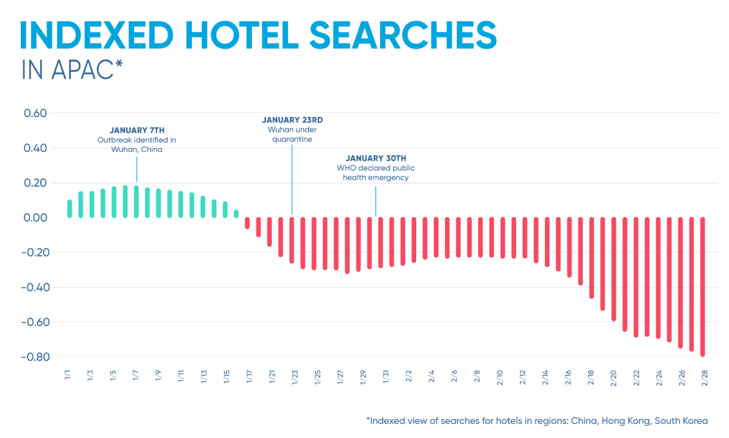
[source Koddi]
This high level of volatility can render any hospitality business from prosperity to survival mode threatening its overall existence.
In our attempt to help as many hoteliers as possible navigate successfully through this truly difficult situation we are beginning this two-part series.
In this first article we describe 5 critical mistakes 80% of businesses make in moments like this that ultimately bring them in the brinks of bankruptcy while in the second part we give you 5 tips that will help you avoid being in that category and successfully navigate through this crisis.
Now without any further ado lets jump right in
1. No email marketing or existence of a past guest database
This absence of an email marketing strategy stems from the over reliance of the hotel industry to OTAs.
Don’t get me wrong there are in general a lot of reasons why we need to include the Online Travel Agents (OTAs) in our basket of options as it improves our distribution mix in general.
However, there are some important aspects in the OTAs operating plan that need to be considered.
I am not going to write here about their commission part or their tendency to push rates lower through their own loyalty programs and packaged deals (I am mainly referring to Booking.com and Expedia group here). This theme goes beyond the scope of this article.
What I want to focus on here is the fact that OTAs do not disclose the email address of our guests. By retaining their email address, hoteliers do not have the opportunity if they don’t capture the email address in the property, to contact their past guests again in the future since the temporary email address we are provided at the time of booking expires in roughly a 1 month period after check out. Thus, after their stay they are not hotel past guests anymore but in essence are OTAs customers.
Why is that so important for our hotel business?
Email marketing has been the base of OTAs tremendous growth from the very beginning. They have been utilizing their rich base of customers in order to increase their market share in the online booking game and this is exactly why they are going to regenerate their business after the whole Corona virus situation is over much faster than a lot of hoteliers that are left with nothing but more dependence to the OTAs.
2. Relying only in guests from one country
Travel restrictions are present to even more and more countries as Corona virus has been spreading around the world.
However, not all countries are in equal footing. Some of them do face more difficult situations than others, and maybe some of them have not yet begun.
It is highly unlikely that all countries will lift their restrictions at once allowing their citizens to travel. As we move further into the crisis it becomes clear that some of the countries will be affected more and others will rebound sooner.
Hotel businesses that only relied into guests from one single country might find themselves in a difficult situation and will be forced to either reconsider and change their policy or suffer huge losses due to their guests not being able to travel.
3. Acting emotional and stopping all kinds of activities due to the current situation
Many hoteliers and b&b owners feel paralyzed on this unprecedented situation.
Although it is fully understandable that any kind of activity would be difficult, hoteliers can use this opportunity to rethink their old strategies and craft new ones, negotiate some of their expenses fixed or variable ones that are deemed high in order to improve their overall processes and make a plan of action on moving forward.
Because and make no mistake about it, crisis moments are sure to come but also are sure to go after a while. Remember the 9/11 or the global financial crisis of 2007-8. It is exactly those times of crisis, where businesses that are better prepared will be the ones with higher chances of survival.
4. Lowering room rates at a level where hoteliers are not even able to cover the expenses
This is another typical mistake a lot of our fellow hoteliers make.
It is completely reasonable to lower our rates when we are going to be allowed to open. But lowering rates cannot not be a viable option for your hotel especially in the medium to long run and here is why:
- It is much more difficult to get back to your normal rates once you have committed to the much lower ones
- Since demand it quite low in those moments it is highly likely that you will operate at a far lower rate than your maximum occupancy. With very low rate you decrease the bottom line of your revenue to such a level that is not easy to even cover the variable and fixed expenses.
- Decreasing your rates might create a snowball effect from guests that have booked already with you but have not cancelled yet. They might see the lower rates and request the same low rates as well hurting your revenue even more.
From all the above reasons it is clear that decreasing your hotel rates is a tactic that has to be used with caution and limited to a small number of people with certain criteria.
5. Drop quality
This is a mistake that comes as a result of reduced earnings. Maybe prices are not in their best or the number of reservations you have received is too low as a result your earning are not in their best shape.
Many hoteliers will be tempted to drop the quality of the provided service in order to cope with the problem of declining revenues.
The problem with this approach, even though a very logical one, is that when you drop your quality you risk increasing the number of dissatisfied guests and this in terms increases the possibility to receive bad reviews.
Especially in a period where the number of bookings is not going to be at the same level as in a normal environment, receiving an increased number of negative reviews can negatively impact your future booking performance.
If you found the information useful we would highly appreciate it if you can share this article with fellow hoteliers. In those difficult moments having access to such information can make or break a hotel business. Help us spread the word and save as many hotel businesses as possible!
Looking for the second part of the series? Click here to read our article on The 5 most important actionable tips that will help you successfully navigate through this Corona virus crisis?