This is the golden era for online reservations. According to a study from online travel booking statistics “82% of all travel bookings were made online without the help of human interaction”. However, finding new customers that book direct can be a challenge for hotels these days.
Why it that?
The rise of Airbnb has increased competition for hoteliers that are now seeing their share in the hospitality market shrink. At the same time booking.com has strongly established its loyalty Genius program that gives guests a 10 & 15% discount and Expedia group tends to favor its packaged hotel and flight program (with hoteliers providing a 10% discount) more than the standalone bookings. All the above are great developments for the OTAs but can hurt substantially the profitability of hotels and make them even more dependable into those sources for bookings.
Increasing direct bookings seems to be the only way to turn the tides for Hoteliers. And we have heard a lot of things on how to increase direct bookings. Suggested solutions include but are not limited to investing in Google pay per click advertising, use metasearch tools such as Trivago, Kayak and Google Hotel Ads, update often in social media even advertise with them. Although all the above are a great way to increase your direct bookings, you will often need a large budget to see tangible results, a lot of time to set it up, monitor and maintain.
How about multilingual content? You just need to give a translation agency the content and in a few days they hand you the translation. You then upload it on your website and that’s it! You have finished. No need to update the same content, no need to monitor it. You set it, it is working for you and you forget about it!
Not convinced yet?
This article gives you 3 additional reasons why creating a multilingual website can be a very simple yet powerful way for hoteliers in order to gain trust, reduce commissions, fill their hotel in the slow season and increase their overall revenue.
1. Open your Hotel business to global markets
According to a study published by the United Nations World Tourism Organization (UNWTO) and also featured in various sources, among those on GTP the highest place on the top spenders list belongs to China with spending over 277.3 billion dollars. This is a country where English is not the mother tongue language.
Are there more countries that share this same characteristic on this list?
You bet there are!
The top 10 list has 5 more countries (so 6 in total!) where English is not a native language. This is 60% of the countries and we are only talking about the top spenders here.
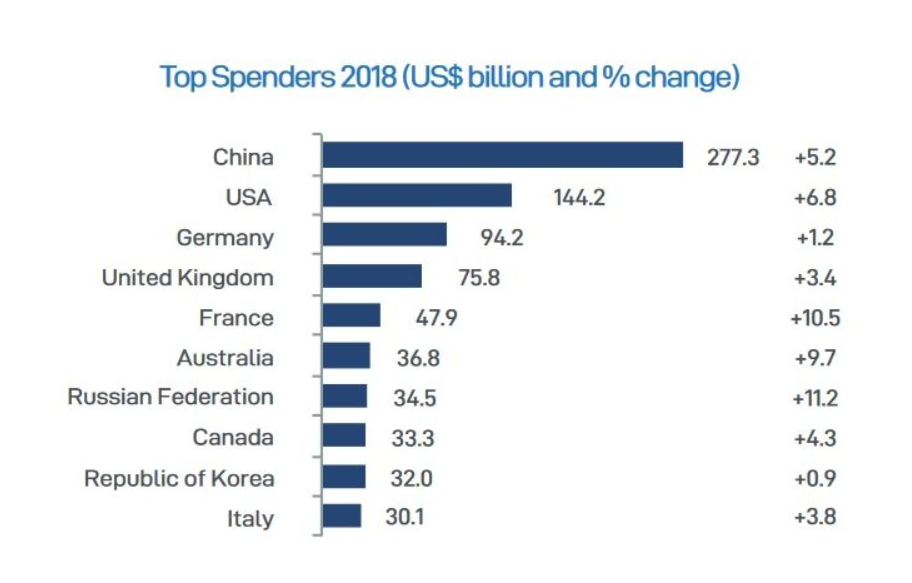
Table source gtp
It is also important to note that, according to Table 1 the Russian Federation and France are the 2 countries with the highest year on year percentage growth with 11.2% and 10.5% consecutively. The study by Cornel University reveals that more than 65% of travelers that made a reservation through the official website visited an Online Travel Agent (OTA) before making a booking. Now imagine those French, Russian, Italian or Chinese travelers landing on your website for more information on your property.
What will happen if your website content is written in a language they cannot understand?

That’s right! They are going to leave and book your hotel through an OTA or worse visit your competitor’s website where they can understand the content…

Moral of the story?
Having your website translated into French, Russian or any other language you are targeting, gives you a higher chance to attract those travelers and convince them to stay in your hotel.
2. Reduce bounce rate, increase time spent on hotel website and ultimately increase conversions
According to a study published by CSA research dedicated to non-English speaking global consumers, reported that more than 60% of them would rarely or not buy at all from an only English website.
Think about it, would you buy from a website that would only show content on this language?
מלון יפהפה זה במרכז העיר לא רק ידהים אתכם עם היופי הייחודי והסגנון המודרני שלו, אלא גם עם הצוות המדהים והמיומן והמעוזר שלו.
I can now hear you say, “I will use Google to translate the content.” This is quite questionable, as machine translations often lack on quality misinterpreting parts of the original text.
I don’t know about you, but I would not risk buying a product or service when payment or delivery terms were solely depicted in a language I did not understand even with the assistance of on automated translation software.
In addition, according to the same study about 75% of the respondents prefer to make a purchase in their mother tongue language while 56% stated that they stay more time in websites that contain their native language.
Since people are staying more on the website it reduces the possibility of them bouncing off and gives you more time to convince them you are the right choice for their holidays, ultimately leading to more website conversions.
3. Higher chance to fill your empty rooms in the slow season
Regardless of the area your hotel is located there is busy season where demand for your rooms is high and a slow season where demand is quite low.
How can hotels set themselves up to reduce the possibility of their rooms left unsold during the slow season?
Targeting independent international travelers is a great strategy to increase your chances on filling your hotel during the slow season.
Here is why
- With the rise of flight companies with cheap fares, people can travel anytime anywhere with minimal cost. Since flight fares tend to be much lower in the slow season, it gives an additional incentive to travel abroad and visit your hotel.
- International travelers tend to stay longer and spend more money since they have saved up throughout the year for a lot of weeks of annual leave.
- They are looking for a great value for money deal which they can easily find in slow season periods where price is lower.
- They love unique and personalized experiences and are willing to travel in the slow season to get a better feeling of the culture and avoid large crowds.
- After the Corona virus pandemic, peoples need to travel in periods where less travelers will be around will become more and more prevalent.
Overtourism can be another important factor on a potential change of traveler visits from high to slow season months. According to a study published by Skift travel agencies have already taken a stand to promote travel over lower season months in order to counter the even increasing phenomenon of overtourism. According to the report those slow season packages are growing faster than the higher season months and are sure to grow even more in the future. Thus, it is safe to conclude that the number of people around the world who would prefer or will be forced due to state limitations to travel in the slow season both packaged and independent travelers is expected to increase in the years ahead.
From all the above it becomes clear that localizing your hotel website and content into different languages can significantly help you improve your hotel’s performance in a lot of different ways.
However, it is important to note that one size does not fit all. Some languages can be valuable for some hoteliers but completely unworthy for others. An easy way to decide which ones to choose is by looking on the nationalities of visitors already visiting your hotel.
All in all, it can be tempting for hoteliers to translate their website and content in as many languages as possible. However, we would advise you not to rush into it right away.
First, focus on the languages that represent the largest number of people visiting your hotel. Create guides, articles on wonderful trips nearby your hotel, welcome emails or just hotel directions into their own language. To put it simply, create content in their own language that will give them higher levels of satisfaction, reduce your cancellations, increase the loyalty of your guests and improve your hotel’s reach into an audience of the same nationality.
Target first and foremost the native languages of guests you welcome more often in order to realize the highest return on investment.
Then judging from your results, consider if adding an additional language would be worthwhile for your property.
Here at Pain Free Translations, we help hoteliers every day to reach their ideal audience through translating their website, contents and guides in their preferred language at affordable rates. We are dedicated into providing our hotel clients translated content and material that improve their conversions and relations with their guests. We are eager to help your hotel improve those aspects as well!
Click here to receive our offer to translate your documents in real time or contact our sales team today for a personalized offer.